
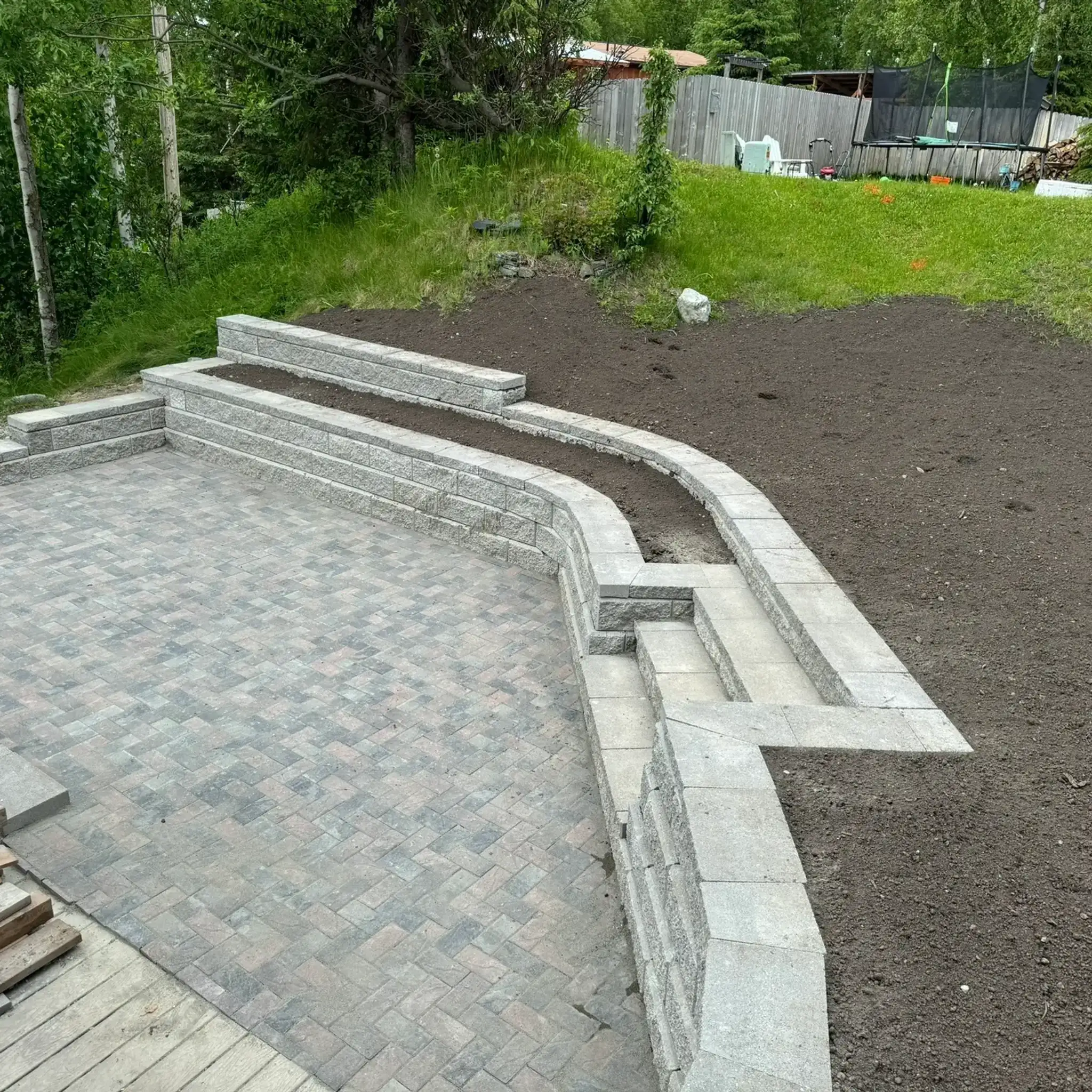
A retaining wall in Anchorage is not holding back soil so much as holding back water and ice. Any wall can look square the week it is finished. The question is what it looks like after the ground has frozen solid, swelled, and settled again.
Why walls fail here
Almost every failed wall we are called out to has the same cause: water trapped behind the blocks with nowhere to go. When that water freezes it expands, and the pressure has to go somewhere. It goes forward, into the wall.
The signs are easy to read once you know them:
- A wall that leans out at the top but is still tight at the base
- Blocks that have stepped forward out of line with their neighbours
- Standing water or soft ground behind the wall after a rain
- Cracking that opens in spring and closes again in summer
What a wall built for this climate needs
A base that goes below the trouble
The base is the part nobody ever sees and the part that decides everything. It is excavated, compacted in lifts, and levelled before a single block is set. Building on undisturbed native soil is not the same as building on soil that has been dug and dropped back in.
Free-draining backfill, not the soil that came out
Backfilling with the excavated soil puts the problem straight back behind the wall. Clean angular stone lets water fall through instead of collecting.
Somewhere for the water to actually go
Drainage stone alone is only half of it. Perforated pipe at the base of the wall, laid to fall and daylighted somewhere sensible, is what carries the water away from the structure rather than parking it there.
Reinforcement where the height asks for it
Past a certain height, and on any slope, a wall needs geogrid tying it back into the soil behind. Where that height sits depends on the wall, the soil and what is above it — which is exactly what a site assessment is for.
Repair or rebuild?
If the base has moved, resetting the blocks buys a season or two at best. If the base is sound and the problem is drainage, the fix can be far less invasive. Knowing which one you are looking at is the first thing we work out on site.
Thinking about a wall, or worried about one you already have? Tell us about your project and we will arrange a look.